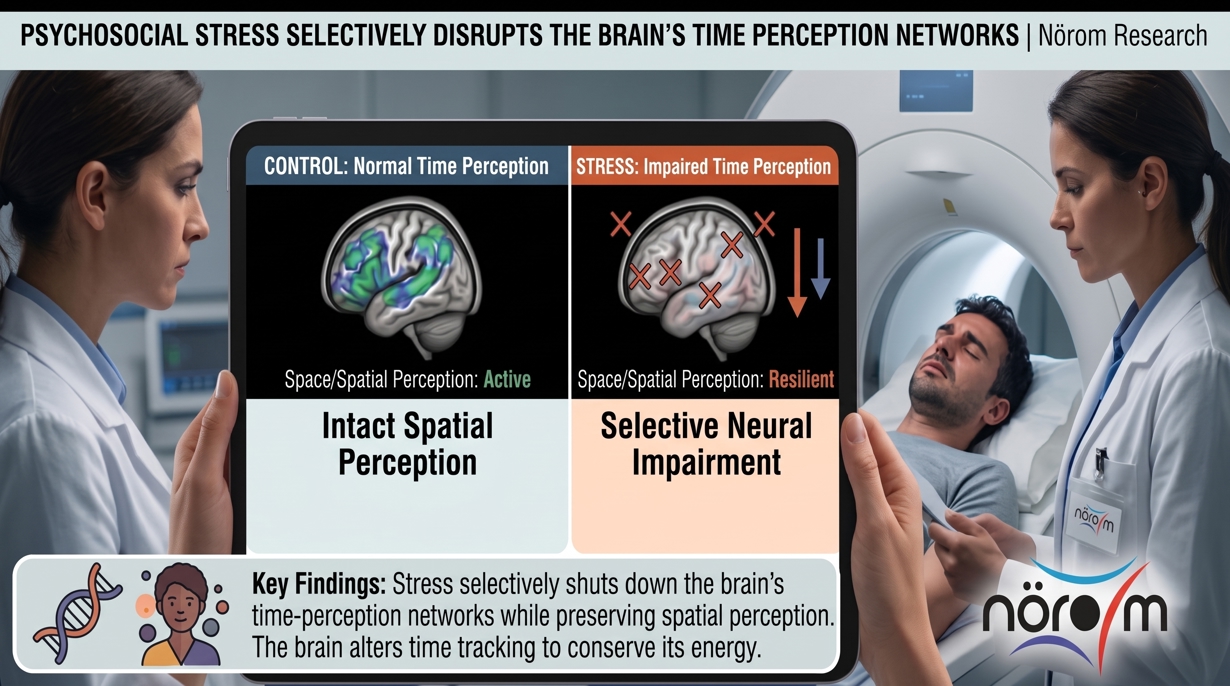
During challenging moments, such as periods of stress, our perception of time changes, and elapsed time can feel much longer than it actually is. A new study conducted within NÖROM mapped the neural and molecular foundations of this perceptual deviation using functional magnetic resonance imaging (fMRI) technology.
Task-Specific Dissociation in Time and Space Perception
In this study, conducted within NÖROM, 45 healthy volunteers with a mean age of 23 were examined. While under brain imaging (fMRI) scanning, the participants were exposed to specially designed stressful conditions. They were asked to complete various tasks aimed at perceiving both time and space during this process. That the participants were truly under stress was also confirmed by regular cortisol measurements.
The data obtained were quite striking. Stress significantly reduced neural activity in the frontoparietal network (ventrolateral prefrontal cortex, superior temporal gyrus, inferior frontal gyrus, and intraparietal sulcus), which governs the brain's perception of time. One of the most striking findings of the study was that the perception of "space," managed by the same brain regions, remained entirely unaffected by stress, thus preserving its resilience. In other words, rather than affecting the brain globally, stress selectively disrupted only time perception.
Although participants continued to complete the requested tasks successfully, it was clear that stress suppressed these time networks in the brain. The researchers explain this situation as the brain restructuring its available mental resources under stress and withdrawing its energy from "keeping track of time" to redirect it toward other directions.
Epigenetic Tendencies and Clues Shaping the Future
In the study, alongside neural processes, epigenetic alterations (methylation) in 5 stress- and dopamine-related genes were examined to elucidate the genetic architecture of individual differences in stress responses. The analyses revealed some trends in the relationship between genetic variability and stress-induced neural changes.
These genetic examinations, conducted in addition to the study's core neural findings, are currently evaluated by the researchers as "preliminary findings." The data obtained regarding the role of individual genetic differences in this process offer valuable clues to guide future research rather than being a definitive conclusion.
In general terms, this research maps out a concrete neural framework for the disruptive effects of stress on time perception, while emphasizing that larger-scale studies are needed to solidify aspects of the process in relation to genetic and individual differences.
NÖROM Research: Psychosocial Stress Selectively Disrupts the Brain's Time Perception Networks
Hidden Danger in Traffic: NÖROM Research Reveals the Effects of Migraine on Driving Safety
First in Turkish: R-Based Clinical Reading Assessment Tool Developed
Researchers at NÖROM Discover Protein Connection Between Chronic Migraine and Cognitive Complaints
First, They Spiked in Their minds, Then They Became World Champions!