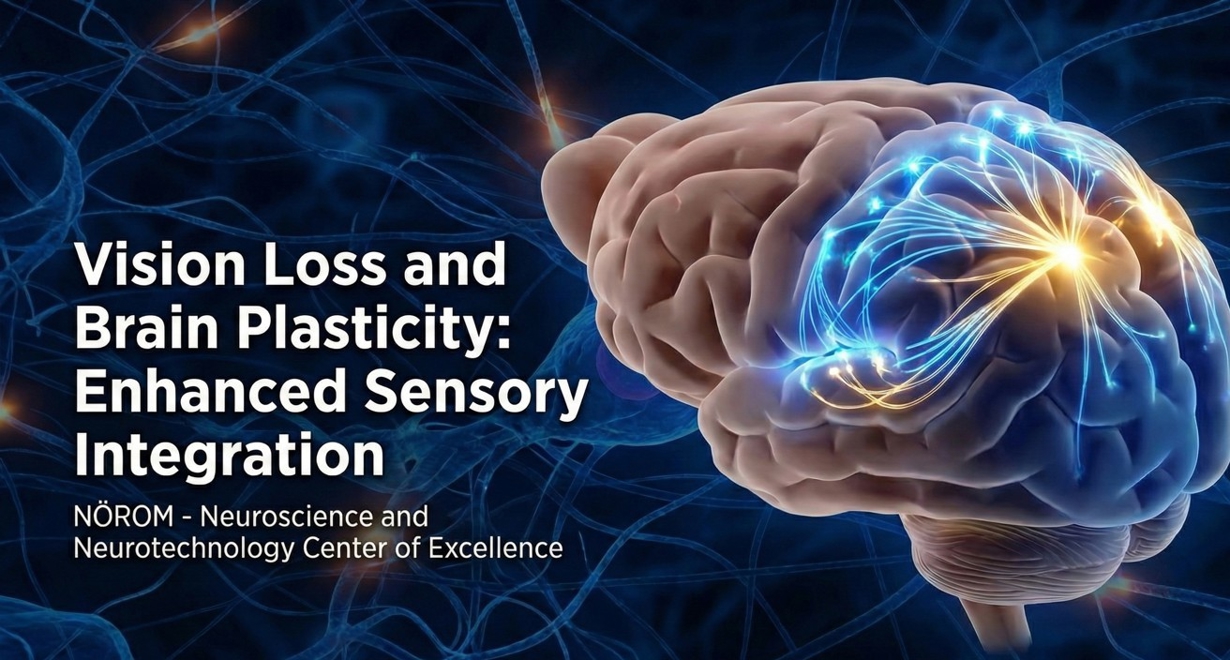
The Brain’s Hidden Superpower: NÖROM Study Reveals How We Adapt to Sensory Loss
Have you ever heard the saying that when you lose one sense, the others become sharper? A fascinating new study conducted at the Neuroscience and Neurotechnology Center of Excellence (NÖROM) has uncovered the biological "wiring" behind this phenomenon.
Our brains are not static machines; they are constantly changing and adapting. This ability is called "neuroplasticity." In this recent study, researchers investigated what happens inside the brain when vision is lost. Using a mouse model, they discovered that the brain doesn't simply let the unused visual areas go to waste. Instead, it remarkably reorganizes itself to boost the remaining senses—specifically the sense of touch.
Key Discoveries for Everyone:
- The Brain is Efficient: When input from the eyes is reduced, the brain strengthens its connections related to touch (in mice, this involves their whiskers). It’s as if the brain says, "We can't see as well, so let's make sure we can 'feel' the world better."
- Rewiring the Highways: The study found that a specific part of the brain called the thalamus (which acts like a central relay station) starts sending stronger signals to the area responsible for processing touch. It essentially builds "wider roads" for sensory information to travel on.
- Better Integration: This rewiring leads to "enhanced multisensory integration." In simple terms, the brain becomes better at combining different types of information to make sense of the environment, compensating for the missing visual data.
Why Does This Matter?
This research is crucial because it helps us understand the resilience of the human brain. It provides hope and scientific backing for rehabilitation therapies for individuals with sensory impairments. By understanding exactly which circuits the brain changes to adapt, scientists can develop better ways to help patients recover or adjust to vision loss in the future.
The study serves as a powerful reminder: even when facing a loss, the brain finds a way to bounce back and adapt.
NÖROM Research: Psychosocial Stress Selectively Disrupts the Brain's Time Perception Networks
Hidden Danger in Traffic: NÖROM Research Reveals the Effects of Migraine on Driving Safety
First in Turkish: R-Based Clinical Reading Assessment Tool Developed
Researchers at NÖROM Discover Protein Connection Between Chronic Migraine and Cognitive Complaints
First, They Spiked in Their minds, Then They Became World Champions!