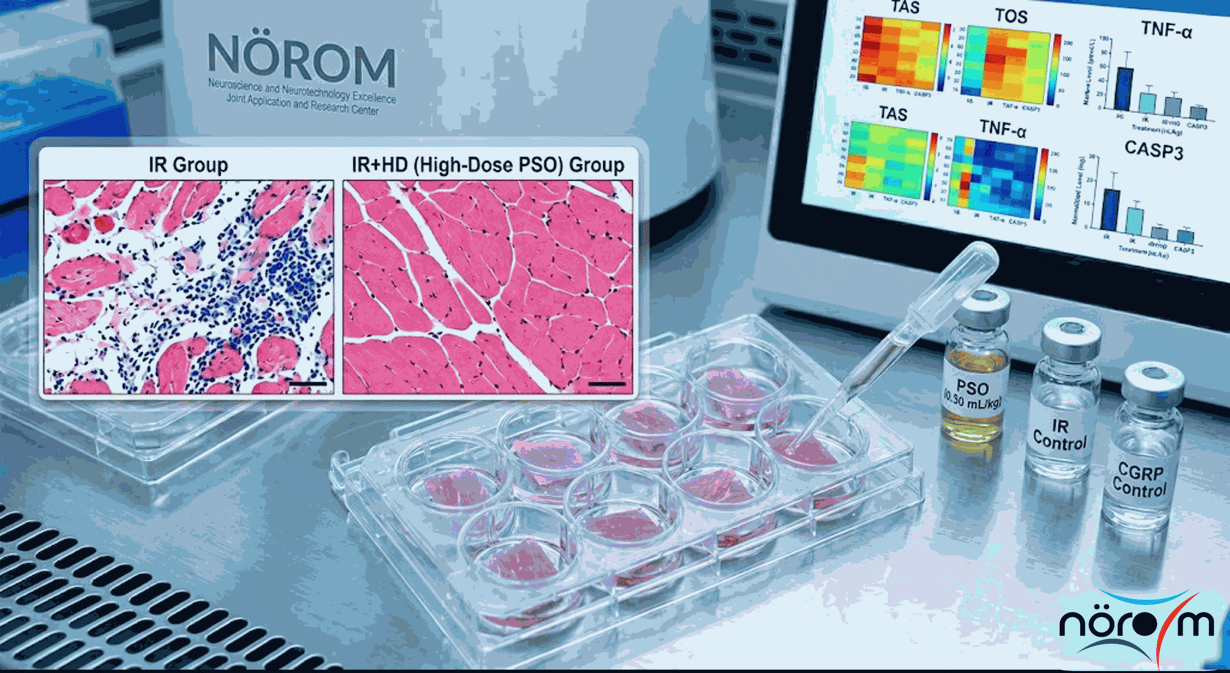
This study, conducted within NÖROM, reveals the inhibitory effect of pomegranate seed oil on oxidative stress and programmed cell death developing during ischemia-reperfusion injury.
The process of interrupting blood flow to tissues for a certain period and the subsequent return of blood to the tissue (ischemia-reperfusion) is defined in the medical world as a complex process where, contrary to tissue healing, damage actually deepens. This study revealed that pomegranate seed oil can limit the biochemical destruction occurring at this critical stage at the cellular level.
Although the resumption of blood flow is essential for tissue viability, the excessive production of free radicals and inflammatory molecules during this phase leads to structural degradation in healthy muscle fibers. Researchers analyzed the effectiveness of pomegranate seed oil in halting this damage cycle through specific molecular markers.
Suppressing Tissue Inflammation and Preserving Cellular Integrity
The study, which modeled circulatory disorders in the lower extremities using rats, examined how pomegranate seed oil stabilizes the body's antioxidant capacity, especially when administered in high doses. Researchers discovered that this natural component significantly modulates oxidative stress and apoptosis within the cell.
Key Scientific Discoveries:
- Restoration of Oxidative Balance: According to the research data, pomegranate seed oil treatment reduces total oxidant status (TOS) levels that lead to oxidative stress in the tissue, while significantly increasing total antioxidant status (TAS), which represents the cell's defense capacity.
- Suppression of Inflammatory Signaling Mechanisms: In the study, it was determined that TNF-α, one of the main cytokines triggering inflammation, and NF-κB proteins, which carry damage signals at the genetic level, were suppressed by pomegranate seed oil. This prevents inflammation-induced degeneration (the disruption of the normal structure of tissues) in muscle tissue.
- Inhibition of Apoptotic Processes: It was observed that the release of the Caspase-3 enzyme, which drives the cell toward apoptosis, and Cytochrome C, an indicator of mitochondrial damage, decreased with the use of pomegranate seed oil. This finding indicates that the compound preserves tissue integrity by limiting the cell's self-destruction mechanism.
These encouraging results offered by pomegranate seed oil indicate that it holds strong potential as a natural therapeutic agent for the management of ischemia-reperfusion injury. This study establishes a scientific basis for evaluating the effectiveness of pomegranate seed oil in tissue damage related to circulatory disorders. However, for these findings to be translated into clinical practice, they must be supported by new academic studies, particularly to determine long-term effects and ideal dosage regimens.
Bozok, Ü. G., Ergörün, A. İ., Küçük, A., Yığman, Z., Dursun, A. D., & Arslan, M. (2025). Effects of Pomegranate Seed Oil on Lower Extremity Ischemia-Reperfusion Damage: Insights into Oxidative Stress, Inflammation, and Cell Death. Medicina, 61(2), 212.
https://doi.org/10.3390/medicina61020212
Our Center NÖROM Has Joined EBRAINS AISBL as an Associate Member
An Event Titled “From Digital to Traditional, Awakening from Screen to Field” Was Organized
NÖROM Research: Protective Effects of Boric Acid on Sepsis-Induced Organ Damage
Prof. Hayrunnisa Bolay Belen Delivered the Final NÖROnoM Seminar of the Academic Year