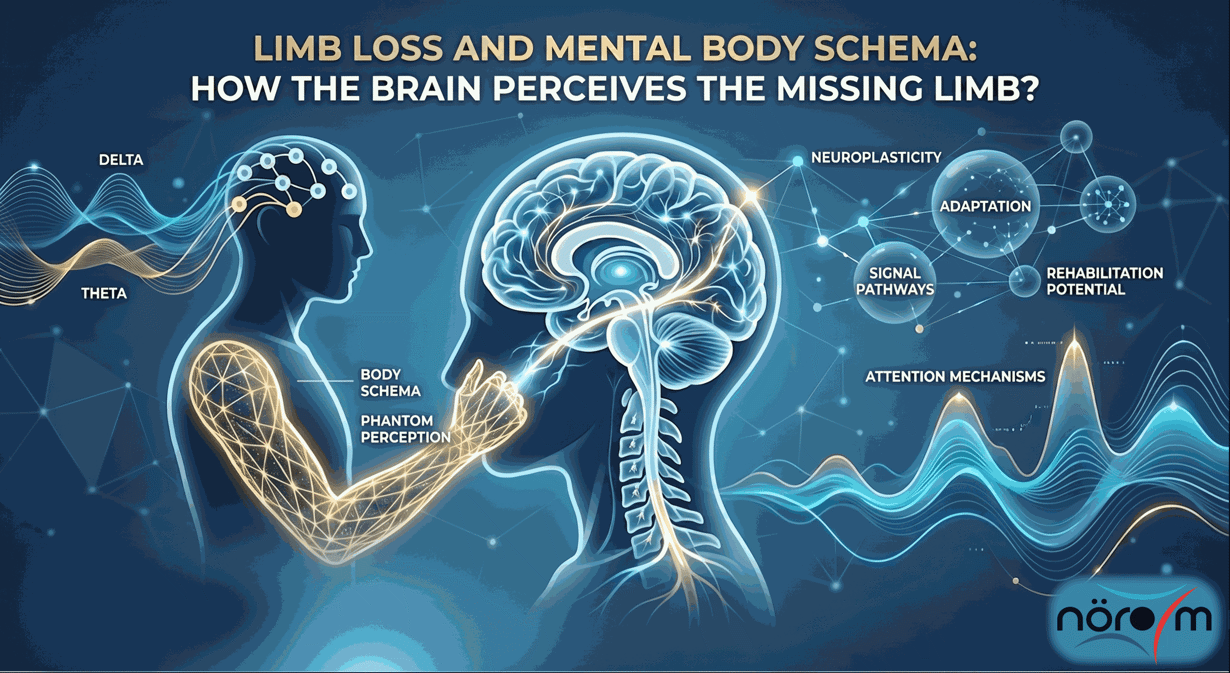
This research, conducted by NÖROM researchers, reveals the electrophysiological evidence underlying body perception and attention processes in individuals who have experienced limb loss.
The loss of a limb (amputation) is not only a physical deficit but also a complex process that leads to radical changes in the brain's mental map, which we call the "body schema." A new study conducted within the Neuroscience and Neurotechnology Center of Excellence (NÖROM) examined the attention mechanisms and changes in brain waves in the central nervous system of individuals with upper and lower limb loss, providing critical data for neurorehabilitation processes.
The research scrutinizes how the brain performs during visual and mental tasks after amputation and the reflections of this process on low-frequency waves in the brain.
Changes Occurring in Mental Rotation and Body Attention
In the study, where individuals with upper limb and lower limb loss were compared with healthy control groups, participants were given a "hand lateralization" task based on right/left discrimination of hands and their positions at different angles. These tests, performed accompanied by electroencephalography (EEG) recordings, analyzed how the brain mentally processes limbs and focuses attention.
Key Scientific Discoveries:
- Angular Difficulty and Learning Capacity: Participants distinguished hand images in natural positions (0°) with much higher accuracy compared to inverted (180°) images. One of the most striking findings was a significant increase observed in the accuracy rates of all participants after the training was administered; this indicates that the brain's adaptation ability is preserved.
- Upper Limb Loss and Response Times: According to the research data, it was determined that individuals with upper limb loss (ULA) had slower task completion and response times compared to those with lower limb loss (LLA). This suggests that the intensive use of upper limbs in daily life may be related to their representation area in the brain.
- Changes in Delta and Theta Waves: EEG analyses revealed a more pronounced increase in Delta (1.5–3 Hz)wave power in the brains of individuals with upper limb loss compared to healthy individuals. After the training, the increase in Theta (4–7 Hz) wave power proved that the brain became more aligned with the task as attention was incorporated into the process.
Why Is This Important?
This study, conducted by NÖROM researhers, establishes an important foundation for understanding the attention mechanisms in the central nervous system following amputation. The behavioral and electrophysiological findings obtained emphasize the importance of attention-focused approaches in neurorehabilitation strategies to be developed for individuals with limb loss.
Understanding the brain's oscillatory responses in this process may enable the improvement of personalized rehabilitation protocols and prosthetic adaptation processes in the future. The research team states the necessity for further studies with larger groups to further clarify these mechanisms.
Dilek, B., Zapała, D., Augustynowicz, P., Yildirim, E., Szubielska, M., Guntekin, B., & Hanoglu, L. (2026). Differential Effects of Lateralization-Task and Training on Low-Frequency EEG Oscillations in Upper- and Lower-Limb Amputees. Psychological Reports, 0(0).
NÖROM Research: Psychosocial Stress Selectively Disrupts the Brain's Time Perception Networks
Hidden Danger in Traffic: NÖROM Research Reveals the Effects of Migraine on Driving Safety
First in Turkish: R-Based Clinical Reading Assessment Tool Developed
Researchers at NÖROM Discover Protein Connection Between Chronic Migraine and Cognitive Complaints
First, They Spiked in Their minds, Then They Became World Champions!